


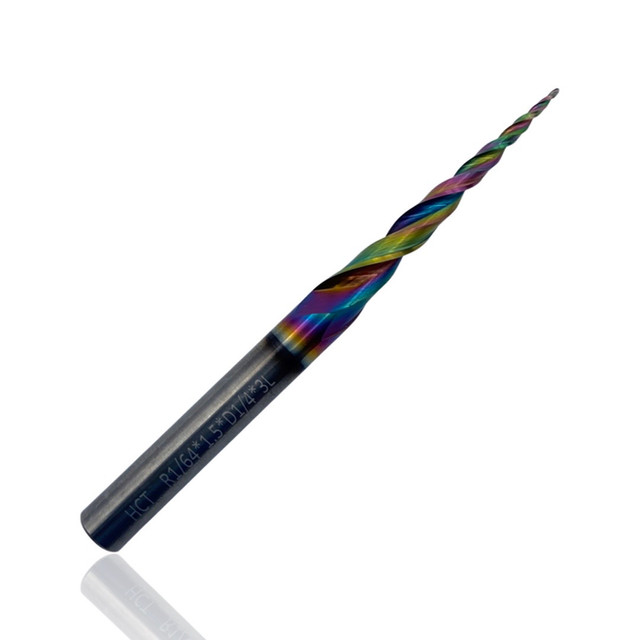


A tapered ball nose (TBN) is a CNC bit with a rounded tip on a cone-shaped body. The small tip carves fine 3D detail; the taper makes the bit far stiffer than a straight bit with the same tip, so it can reach deeper without snapping. It is the standard finishing bit for 3D relief carving, signs with sculpted lettering, carved panels and textures.
The short version:
- Pick the tip by the smallest detail you need to carve: 1/8" for large reliefs and flags, 1/16" for most detailed work, 1/32" for faces, feathers and fine texture.
- Rough first, then finish. Clear most of the wood with a flat end mill or a roughing end mill, then run the TBN over the surface.
- Set finishing stepover to about 7–8% of the tip diameter. Smaller is smoother but slower.
- Match feeds and speeds to your machine. Tiny tips break from too much depth or plunge, not from moving too fast.
Tapered Ball Nose vs. Straight Ball Nose
A straight 1/16" ball nose is 1/16" wide its whole length, so it bends and snaps if you ask it to reach more than a few tip-widths deep. A tapered ball nose keeps the same 1/16" tip but widens toward the shank. That extra metal is what lets a tiny tip carve a deep relief.
How fast the body widens depends on the side angle: the angle of each side from vertical.
The trade-off: a wider body can't fit into narrow, deep gaps between features. A low side angle (like the 1°) keeps walls closer to vertical in deep detail; a larger side angle gives a stiffer bit. A straight ball nose still wins for flat-bottomed fluting, coves and large smooth contours, where a 1/4" or 1/2" ball nose finishes faster.
Choosing a Tip Size
Pick the largest tip that still carves your smallest detail. A bigger tip is stronger, runs faster and needs fewer passes; a smaller tip catches finer detail but multiplies machining time.
| Bit | Part no. | Tip | Side angle | Flute length | Shank | Flutes | Price | Best for |
|---|---|---|---|---|---|---|---|---|
| 1/32" Tapered Ball Nose | TBN-132-DLC | 1/32" (0.031") | 4.2° | 1-1/2" | 1/4" | 2 | $39.00Out of stock | Faces, feathers, hair, fine texture, small lettering |
| 1/16" Tapered Ball Nose | TBN-116-DLC | 1/16" (0.063") | 3.6° | 1-1/2" | 1/4" | 3 | $39.00 | Most detailed relief carving and finishing passes |
| 1/8" Tapered Ball Nose | TBN-18-DLC | 1/8" (0.125") | 2.5° | 1-1/2" | 1/4" | 4 | $39.00Out of stock | Larger reliefs, signs, 3D carved flags and faster finishing |
| 1/8" Tapered Ball Nose, 1° | TBN-18S-DLC | 1/8" (0.125") | 1° | 1-1/2" | 1/4" | 3 | $44.00 | Deep detail with near-vertical walls |
| XL 1/8" Tapered Ball Nose | TBN-1838-DLC | 1/8" (0.125") | 2.9° | 2-1/2" | 3/8" | 4 | $84.00 | Deep reliefs up to 2-1/2" in one finishing pass |
| 0.5mm Tapered Ball Nose | TBN-05M8-DLC | 0.5mm radius (1.0mm Ø) | 3.4° | 60mm | 8mm | 4 | $54.00 | Fine detail on 8mm-collet spindles |
| 0.75mm Tapered Ball Nose | TBN-75M8-DLC | 0.75mm radius (1.5mm Ø) | 3.1° | 60mm | 8mm | 4 | $54.00Out of stock | General 3D carving on 8mm-collet spindles |
All are solid Japanese carbide with a DLC (Diamond-Like Carbon) coating. The Tapered Ball Nose CNC Bit Set (TBN-SET, $144.00) holds the 1/32", 1/16", 1/8" and 1/8" 1° bits.
Two checks before you buy: metric bits need an 8mm collet, and the XL needs a 3/8" collet. Most hobby routers ship with 1/4" and 1/8" collets only.
Rough First, Then Finish With the TBN
A tapered ball nose is a finishing bit. Running it alone over a 3D model means hours of tiny passes through full-depth wood, and that is when tips break. The reliable workflow is two toolpaths:
- Rough. Clear the bulk with a 1/4" end mill, or a RIPPER roughing end mill for deep reliefs. In Vectric Aspire or VCarve Pro this is a 3D Roughing toolpath; in Fusion 360, Adaptive Clearing. Leave a small allowance (about 0.01"–0.02") on the surface so the finishing bit has something to clean up.
- Finish. Run the TBN over the whole model with a 3D Finishing toolpath (Vectric) or Parallel/Scallop finishing (Fusion). Set the stepover as a percentage of the tip (next section). A raster at 45°, or one that runs along the grain, usually leaves the cleanest surface.
- Optional detail pass. For a very fine model, finish with a 1/16" TBN, then run a 1/32" only over the areas with the finest detail (a face, lettering) using a boundary or selected area. That saves hours compared with running the 1/32" over the whole carve.
Set the tool up correctly in your CAM. A 1/16" tip has a 1/32" (0.03125") tip radius, and entering the diameter where the software asks for radius doubles the tip in the simulation. Vectric asks for the included angle (both sides, so 7.2° for a 3.6° side angle). The free HCT Vectric and Fusion 360 tool libraries come with every bit's geometry and feeds already entered.
Stepover for a Smooth Finish
Stepover is how far the bit moves over between passes. Each pass of a round tip leaves a tiny ridge; a smaller stepover leaves smaller ridges and a smoother surface, but adds passes. For finishing passes, about 7–8% of the tip diameter is recommended.
| Tip | Finishing stepover (8%) |
|---|---|
| 1/32" | 0.0025" |
| 1/16" | 0.005" |
| 1/8" | 0.010" |
| 0.5mm radius (1.0mm Ø) | 0.08mm (0.003") |
| 0.75mm radius (1.5mm Ø) | 0.12mm (0.005") |
The free HCT tool libraries set every tapered ball nose to 8% stepover. Feeds and speeds depend on your machine, so take them from the library for your machine class or the Feeds & Speeds Calculator.
Why Tapered Ball Nose Tips Break, and How to Avoid It
- Skipping the roughing pass. The TBN ends up burying its whole flute length in solid wood. Rough first and leave only a small allowance.
- Plunging straight down. Small tips hate direct plunges. Use the plunge rate from the library, or a ramp in your CAM.
- Too much stickout. Every extra 1/4" out of the collet adds flex. Seat the bit as deep as the carve allows.
- Wrong tool geometry in CAM. Radius entered as diameter, or a side angle entered where the software wanted the included angle, makes the simulation lie. Import the tool library instead of typing it.
- Dull or dirty collets. Runout that a 1/4" end mill shrugs off will snap a 1/32" tip. Clean the collet and nut, and replace worn collets.
- Running a fine tip over the whole model. Finish with the 1/16" and save the 1/32" for the areas that need it.
- Climb vs. conventional on fragile tips. If a fine tip chatters or leaves fuzz in soft or stringy wood, try switching the cut direction before slowing the feed.
Tapered Ball Nose FAQ
What is a tapered ball nose bit used for?
Finishing 3D carvings: reliefs, sculpted signs, carved panels, textures and fine detail. Its small rounded tip follows curved surfaces, and its tapered body keeps that tip stiff.
What size tapered ball nose should I buy first?
A 1/16" covers most detailed carving. Add a 1/8" for larger, faster carves and a 1/32" for the finest detail.
What stepover should I use with a tapered ball nose?
About 7–8% of the tip diameter for finishing passes: 0.005" for a 1/16" tip and 0.0025" for a 1/32" tip. A larger stepover is faster but leaves visible ridges.
Can I rough with a tapered ball nose?
You can, but it's slow and hard on the tip. Rough with a flat or roughing end mill and finish with the tapered ball nose.
Is a tapered ball nose the same as a V-bit?
No. A V-bit comes to a sharp point for V-carving and lettering. A tapered ball nose has a rounded tip for smooth 3D surfaces.
Do I need a special collet?
The 1/32", 1/16" and 1/8" HCT tapered ball noses have 1/4" shanks. The metric bits need an 8mm collet, and the XL needs a 3/8" collet.
Can a tapered ball nose cut aluminum or plastic?
Yes, at lighter settings. The HCT tool libraries include acrylic, HDPE and epoxy presets for every tapered ball nose, and 6061 aluminum presets for most of them.
Shop Tapered Ball Nose Bits
Every HCT tapered ball nose is solid Japanese carbide with a DLC coating, backed by a limited lifetime warranty against manufacturer defects, and ships from Denver in 1–3 business days. Free USPS Ground shipping on orders over $80.
- All tapered ball nose bits
- Tapered Ball Nose CNC Bit Set
- RIPPER roughing end mills for the roughing pass
- Straight ball nose end mills for large contours and fluting
- Free Vectric and Fusion 360 tool libraries
- Feeds & Speeds Calculator