




If you're a woodworking enthusiast, having the right tools for your machine is extremely important. One machine that has gained great popularity among woodworkers for its ease of use and versatility is the CNC router. To unlock your CNC's project potential, you need to invest in several types of quality CNC router bits. These bits not only ensure precise cuts in different materials and applications, they also let you make the most of your machine. Here are the top 5 must-have CNC router bits for woodworkers.
1. Spiral End Mills
The spiral end mill is a staple of CNC woodworking. There are two primary types: upcut and downcut.
Upcut end mills
Upcut end mills are versatile tools for roughing, pocketing, profile cutting and surfacing. They are most often used to clear pockets, rough out 3D carvings, surface spoilboards and cut profiles around project parts. In hardwoods and plywood, an upcut end mill commonly causes some splintering along the top edge of the cut. For its intended job, bulk stock removal, that splintering usually isn't a big concern.
The upcut action ejects chips from the cut channel, which keeps the tool cooler and reduces the chance of re-cutting old chips. Every shop needs good dust collection, but on a CNC it plays a vital role in clearing away the material that has been cut. Re-cutting chips can overheat an end mill, wear the cutting edge faster and even break the tool.
If you only buy one: 1/4" 2-Flute Upcut End Mill ($34.00), the everyday bit for pockets, profiles and roughing.
Downcut end mills
Downcut end mills push the cut down into the wood, which always leaves a crisp edge along the top of the cut. A downcut bit works well for bulk roughing and pocketing as long as your machine has adequate dust collection. Chip removal is what keeps the tool from re-cutting chips and overheating. A quality downcut end mill is my personal choice for roughing and pocketing because it leaves a sharp edge with no splintering.
If you only buy one: 1/4" 2-Flute Downcut End Mill ($34.00), clean top edges on pockets, signs and hardwood.
2. Compression End Mills
Compression end mills serve a special purpose: a clean cut on both the top and bottom faces of the stock. They are typically used for profile cuts, and can also be used for pocketing. A compression bit has a short upcut section at the tip and a longer downcut section up toward the shank. The downcut section shears down into the material and leaves a sharp top edge (like a downcut end mill), while the upcut section at the bottom prevents splintering on the underside. The result is clean edges on both faces.
Compression end mills are most commonly used for sheet goods: plywood, veneered panels and thin hardwoods. We have customers who use our compression tools for tray pockets and for cutting out large furniture parts.
If you only buy one: 1/4" Compression End Mill ($39.00), clean cutouts in plywood and sheet goods.
3. V-Bits
CNC V-bits are the go-to tool for engraving text and designs, and for cutting perfect stars in wooden flags. Different angles serve different purposes:
- 15° or less: intricate, detailed engraving.
- 30°: more versatile. Great for detailed designs, and the right choice for hardwood and end-grain inlays.
- 60° and 90°: full-depth engraving and cutting perfect stars in wooden American flags.
If you only buy one: 90 Degree 4-Flute V-Bit / Chamfer Bit ($26.00), general-purpose signs, lettering and flag stars.
4. Ball Nose End Mills
Ball nose end mills come in two main types: straight and tapered.
Straight ball nose end mills
Straight ball nose end mills are the better choice for less detailed 3D carving: rounded guitar profiles, large decorative panels and wavy designs that don't need fine detail. Their cutting diameter is much larger than a tapered ball nose, which cuts the time needed to finish the carve significantly.
If you only buy one: 1/4" Ball Nose End Mill ($34.00), large, smooth 3D contours and fluting.
Tapered ball nose end mills
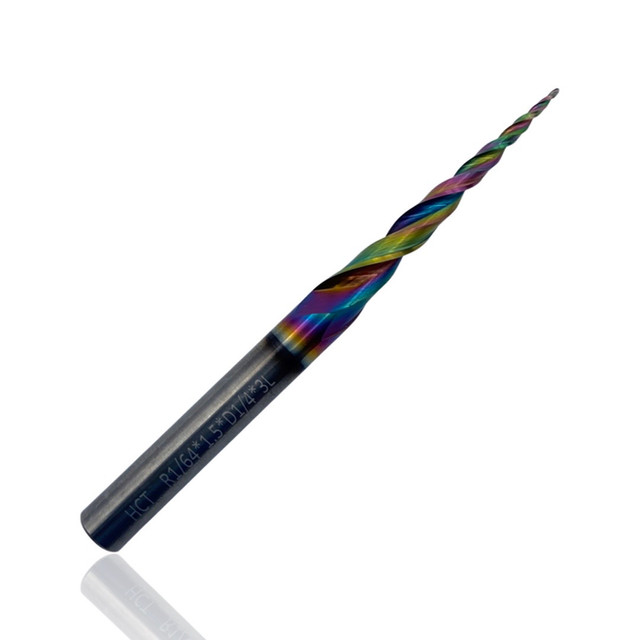
Tapered ball nose end mills (TBNs) are the 3D workhorses of the CNC world. The tip size directly sets both the final detail and the total cycle time of your carve.
- 1/32" TBN: extremely fine detail, mostly used for 3D shields, fine topographic carves and anything that needs the finest detail. Be warned: 1/32" carves can take a very long time, sometimes days.
- 1/16" TBN: a great balance of fine detail and faster cycle times, and my preferred 3D tool. A perfect option for topographic maps, wavy flags and other designs that need quality detail without the extra cycle time.
- 1/8" TBN: a middle ground between the detail of a 1/16" TBN and the speed of a straight ball nose. A great option for large 3D carves, roughing passes before 3D finishing, or carves that don't need fine detail.
For tip sizes, stepover and how to avoid broken tips, see the tapered ball nose guide.
If you only buy one: 1/16" Tapered Ball Nose ($39.00), the best balance of detail and carve time.
5. Carbide-Tipped Shaping Bits
Carbide-tipped shaping bits come in a wide variety of shapes and sizes. Their profiles are made mainly for moulding, frame edges and rounded profile cuts. A shaping bit cuts these edges quickly and accurately, work that would otherwise take hours with ball nose or TBN toolpaths.
If you only buy one: 1/4" Shank CNC Point Roundover ($24.00), rounded and decorative edges cut on the CNC.
The Bottom Line
Having the right bits is critical for any woodworker running a CNC router. Quality, purpose-built tooling is what lets you create products you're proud to build and sell. The top 5 must-have bits:
- Upcut and downcut spiral end mills
- Compression end mills
- V-bits
- Ball nose and tapered ball nose end mills
- Carbide-tipped shaping bits
Get the Essentials in One Set
The Starter CNC Bit Set ($235.00, out of stock) covers most of this list in one box: upcut and downcut end mills, a 1/8" upcut for detail, a 1/4" compression bit, 1/8" and 1/16" tapered ball noses, and 60° and 90° V-bits. HCT bit sets cost less than buying the bits one at a time.
CNC Router Bit FAQ
What CNC router bits should a beginner buy first?
Start with a 1/4" upcut or downcut end mill for pockets and profiles, a 1/4" compression bit for plywood, a 60° or 90° V-bit for signs and lettering, and a 1/16" tapered ball nose for 3D carving. Those four types cover most hobby projects, and the HCT Starter CNC Bit Set includes each of them.
What is the difference between upcut and downcut end mills?
An upcut end mill pulls chips up and out of the cut, so it clears material fast and runs cooler, but it can splinter the top edge. A downcut end mill pushes the cut down and leaves a crisp top edge, but it packs chips into the slot, so it needs good dust collection.
When should I use a compression bit?
Use a compression bit when both faces of the part will show, such as plywood, melamine and veneered sheet goods. Its downcut section keeps the top face clean and its upcut tip keeps the bottom face clean. Cut deep enough that the downcut section reaches the top surface on the first pass.
What V-bit angle is best for signs?
A 90° V-bit is the best all-around choice for signs, lettering and cutting stars in wooden flags. A 60° V-bit carves deeper, crisper lettering. Use a 30° V-bit for hardwood and end-grain inlays, and 15° or less for very fine engraving.
Should I use a ball nose or a tapered ball nose for 3D carving?
Use a tapered ball nose for detailed 3D carving such as faces, flags and topographic maps; its small tip carves fine detail and its taper keeps it strong. Use a straight ball nose for large, smooth contours like guitar bodies and wavy panels, where its bigger diameter finishes much faster.
What shank size do CNC router bits need?
Most hobby CNC routers take 1/4" shank bits, and many also come with a 1/8" collet. Spindles can use 8mm, 3/8" or 1/2" shanks with the matching collet. Check the collets you have before you buy; most HCT bits have 1/4" shanks.
Where do I find feeds and speeds for these bits?
Every HCT product page lists starting feeds and speeds. The free HCT Vectric and Fusion 360 tool libraries have settings for up to 10 materials per tool, and the HCT Feeds & Speeds Calculator adjusts them for your machine, material and depth of cut.
Thanks for reading! All HCT end mills are solid Japanese carbide. Shop CNC bits, grab the free Vectric and Fusion 360 tool libraries, or try the Feeds & Speeds Calculator.